The PGLO team has compiled feedback from more than 1,400 past learners in Provincial Common Orientation to the Care of Older Adults (PCO) program to offer educational providers information to support workforce development programming that can enhance the learning journey of health and social care professionals working with older adults.
Three years of PCO feedback, from more than 1,400 learners, points to a clear next step for workforce development: practical, case-based learning that builds confidence in applying knowledge in complex care.
Turning Knowledge into Action
The Provincial Common Orientation to the Care of Older Adults (PCO) is an 11-week virtual course that provides foundational and applied learning for people working with older adults living with complex health and social needs across Ontario. Over the past three years, over 1400 PCO participants have also told us where they would like to continue developing their knowledge and skills.
When PGLO reviewed their responses, a consistent message emerged: learners are not simply asking for more information. They want support to use what they know in practice.
Learners are looking for opportunities to:
- apply knowledge to realistic and complex situations;
- build confidence choosing, using and interpreting clinical tools;
- translate assessment findings into priorities, care plans and follow-up;
- strengthen clinical reasoning and decision-making;
- work more effectively across professions and sectors; and
- navigate local referral pathways, resources and fragmented systems.
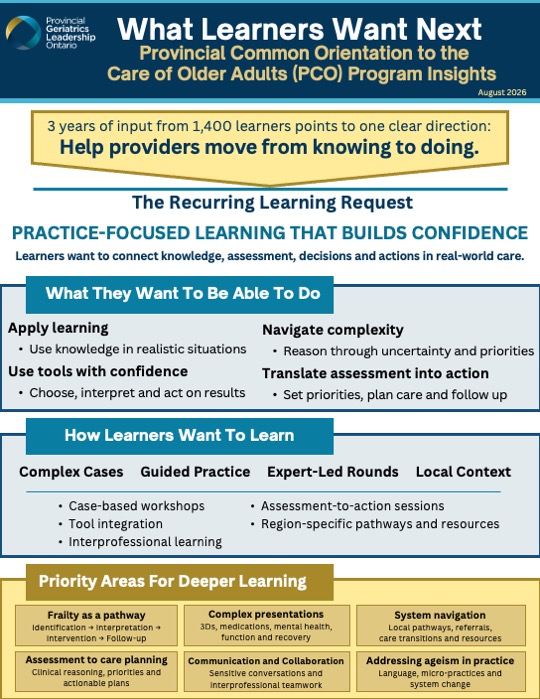
Priority areas for deeper learning
Our PCO learners identified a broad range of clinical topics for further learning. Across these topics, they consistently emphasized practical application rather than a repeat of foundational content.
- Understanding frailty as a clinical pathway
- Learners want to connect frailty identification and assessment with interpretation, intervention and follow-up so that they are not viewing screening as an isolated task.
- Translating assessment into care planning using clinical reasoning
- Learners want increased knowledge and skill on what happens after an assessment: how to interpret findings, prioritize needs, select interventions and build an actionable care plan.
- Managing common but complex syndromes
- Learners want more practice differentiating and responding to delirium, dementia and depression; understanding medication impacts; supporting mental health and substance-use needs in later life; and connecting functional assessment with restorative potential.
- Enhancing communication
- Learners want practical strategies for sensitive conversations with older adults and care partners.
- Navigating complexity within systems
- Learners want clearer examples of how interprofessional collaboration works, and a better understanding of local services, transitions and referral pathways.
How PCO learners want to learn
The learners shared preferred learning formats to support confidence and practice change.
Learners are asking for
- complex case discussions,
- application of content to cases to connect knowledge, decisions and actions,
- guided practice, expert-led sessions,
- interprofessional rounds
- deeper dive on topics
- workshops that move from assessment to action.
- region-specific learning is to understand local services and clinical pathways to work across organizational and sector boundaries.
A shared opportunity for provincial and regional education
The findings reinforce the value of a tiered approach to workforce development. PCO continues to provide a shared foundation for geriatric care, and regional programs and other partners build on that foundation through deeper, locally relevant learning.
Learn more about the Provincial Common Orientation to the Care of Older Adults Program here.